
AI crawlers for AEO: what to allow, what to block, and how to measure the tradeoff
A practical AEO guide to separating training bots, search bots, and user-triggered fetches so you can protect your content without disappearing from AI search.
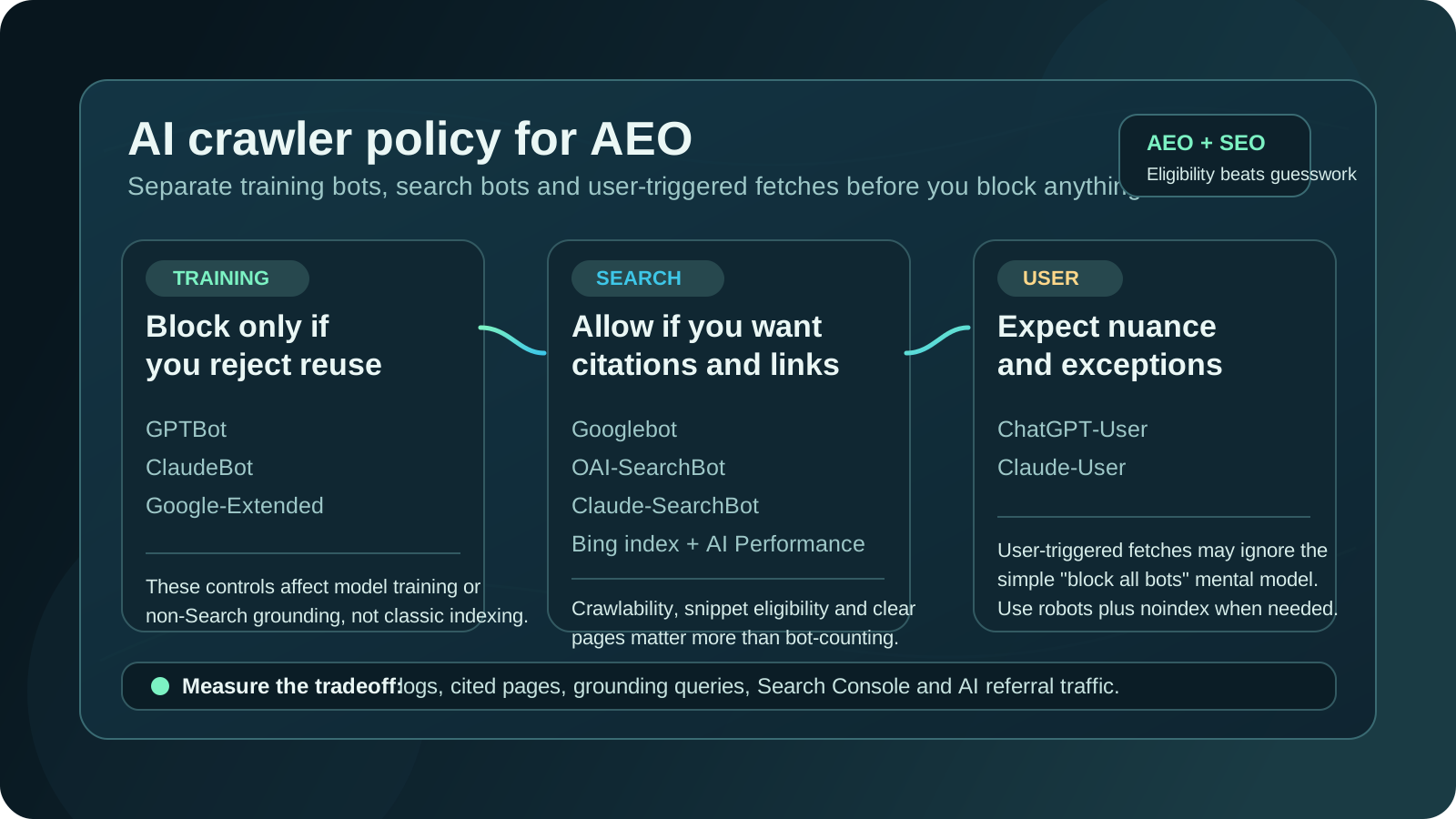
For AEO, the safest default is not to block every AI crawler: separate training bots, search bots, and user-triggered fetches first, then decide which ones you need for visibility, which ones you can refuse, and how you will measure the cost of each choice.
That distinction matters more in 2026 than it did a year ago. Google now documents AI features in Search as an extension of the same crawl and snippet eligibility rules that already govern classic SEO. OpenAI documents OAI-SearchBot separately from GPTBot and says ChatGPT-User is a different, user-initiated fetch path. Anthropic now documents three distinct agents too: ClaudeBot for training, Claude-SearchBot for search quality, and Claude-User for user-directed retrieval. If your robots policy still treats all of those as one bucket called "AI bots," you are making a strategic decision blindly.
Do not treat all AI crawlers as the same thing
The practical split is simple. One family exists to collect public content that may later shape model training. Another exists to discover, index, or retrieve pages for live answer experiences. A third family appears only when a user has just asked a question and the product fetches a page on that person's behalf. Those three uses create different business consequences, different compliance questions, and different AEO outcomes.
- Training bots affect whether new public content can become part of future model development. Blocking them is a content-rights or risk decision, not necessarily a visibility decision.
- Search and retrieval bots affect whether your pages are crawlable, eligible for summaries, and likely to be cited or linked in AI search experiences.
- User-triggered fetch agents sit in between. They are often not used for automatic crawling, yet they can still visit pages when a user asks for something specific.
That is why the old instinct to paste a single Disallow rule for every unfamiliar user agent is weak AEO. It can protect one thing while silently sacrificing another. If you want to appear in ChatGPT search, Claude search answers, Google AI Overviews, or AI Mode, you need to know which family each agent belongs to before you block it.
Training bots: block them only for a deliberate reason
OpenAI's crawler documentation says GPTBot is used to make foundation models more useful and safer, and that disallowing GPTBot indicates your content should not be used in training those models. Anthropic says the same kind of thing about ClaudeBot: when a site restricts ClaudeBot, it signals that future materials should be excluded from Anthropic's training datasets. Google is a little different in how it frames this layer. For Search AI features, Google points site owners back to Googlebot and snippet controls, but it also says Google-Extended can be used to limit AI training and grounding in some of Google's other systems.
The important operational point is that training control is not the same as search eligibility control. A publisher may rationally block GPTBot or ClaudeBot for policy reasons and still allow the agents that matter for search, snippets, and live retrieval. That is often the middle ground serious businesses actually want: do not donate everything to training by default, but do not remove yourself from discovery channels that can send qualified traffic and citations.
Search bots: these are the ones AEO teams usually care about most
If your objective is to be discovered, cited, and linked inside AI experiences, this is the family that deserves the most attention. Google says there are no additional technical requirements for appearing as a supporting link in AI Overviews or AI Mode: a page must be indexed and eligible to be shown with a snippet in Google Search. That means core SEO still does the heavy lifting. Crawlability, snippet eligibility, internal linking, text that can be extracted cleanly, and a healthy technical foundation remain prerequisites.
OpenAI is explicit about the same split. Its publisher FAQ says that for a site's content to be included in summaries and snippets in ChatGPT, you should make sure you are not blocking OAI-SearchBot. It also adds an important nuance: if OpenAI obtains the URL of a disallowed page from a third-party provider or from crawling other pages and judges that page relevant, it may still surface the link and title. If you do not want that, OpenAI recommends noindex. That is a more precise control model than simply yelling at robots.txt and assuming the job is done.
Anthropic now documents Claude-SearchBot in equally direct terms. It says the bot navigates the web to improve search result quality and that disabling it may reduce your site's visibility and accuracy in user search results. That is about as plain an AEO signal as you are going to get from a platform vendor. If you want Claude to discover and understand your public pages for live search experiences, blocking Claude-SearchBot is a real tradeoff, not a symbolic gesture.
User-triggered fetches: the category most teams forget
The third family is easy to misunderstand. OpenAI says ChatGPT-User is not used for crawling the web in an automatic fashion and is not used to determine whether content may appear in Search. Anthropic says Claude-User supports user requests and that disabling it prevents the system from retrieving your content in response to a user query. In other words, these agents are not the same as automatic indexing bots, yet they still matter if you want a model to fetch your page when someone asks for fresh, specific, or comparative information.
This is where many blanket blocking policies become incoherent. A company says it wants visibility in AI assistants, then blocks the search bot, the user bot, or both. Or it blocks only the training bot, thinks it blocked everything, and later discovers that the page can still be linked or fetched in live experiences. The fix is not more paranoia. It is a policy table that names each agent, its purpose, the exact control you want, and the metric you will watch afterward.
A reasonable default policy for most commercial sites
- Allow the bots tied to live discovery and citation if appearing in AI answers matters to the business. That usually means Googlebot for Google Search AI features, OAI-SearchBot for ChatGPT search discovery, and Claude-SearchBot if Claude visibility matters in your market.
- Decide separately on training bots such as GPTBot and ClaudeBot. That is a brand, legal, and content-rights decision, not the same thing as opting out of search visibility.
- Document whether user-triggered agents such as ChatGPT-User and Claude-User are allowed. If a page must never be surfaced, combine robots rules with stronger controls such as noindex where applicable.
- Do not use robots.txt as your only mental model. Google points to snippet and noindex controls for what can be shown in Search AI features, and OpenAI says noindex is the stronger control when you do not want even a title-and-link appearance.
- Keep the site technically boring in the best possible way: real 200s on key pages, real 404s on junk URLs, readable HTML, coherent canonicals, and no contradictory bot-management layer.
How to measure whether your crawler policy is helping or hurting
Good AEO teams do not stop at the robots file. They verify the consequences in logs, analytics, and answer-surface reporting. Cloudflare's AI Crawl Control now gives site owners a dashboard for which AI services access their content, whether crawlers follow robots directives, and how to apply crawler-specific allow and block rules. That is useful because it turns crawler policy from a one-time guess into an observable system.
You should also measure the answer layer itself. Bing Webmaster Tools now exposes AI Performance reporting with total citations, average cited pages, and grounding query phrases. That kind of data does not replace prompt tracking, but it does tell you whether the pages you want to be reused are actually being cited, and for what query patterns. OpenAI adds another concrete measurement path: its publisher FAQ says traffic from ChatGPT search includes the UTM parameter utm_source=chatgpt.com. That means AI referral traffic can be isolated in analytics instead of treated as folklore.
At minimum, the dashboard for this decision should include log evidence of crawler access, indexability of priority pages, cited-page coverage, and referral behavior from AI surfaces. If you change bot access and only watch raw traffic, you will miss the actual AEO tradeoff. The outcome you care about is not bot peace. It is whether better pages become eligible, discoverable, and reusable as sources.
Common mistakes that create invisible self-sabotage
- Blocking every AI user agent but still expecting to appear in AI search results.
- Assuming a training opt-out and a search opt-out are the same thing.
- Relying on robots.txt alone when the stronger requirement is noindex or snippet control.
- Letting a CDN or bot-management layer inject contradictory rules for the same crawler.
- Ignoring the technical basics that still govern eligibility: internal links, canonical signals, snippet eligibility, renderable text, and clean status codes.
The crawler policy that helps AEO is rarely the most restrictive one. It is the one that separates training from search, applies the right control to each, and measures what changed afterward.
What this means for agencies and in-house teams
For agencies, the commercial opportunity is obvious. More clients now understand that AI visibility depends on technical access as much as on content, but very few have a crawler policy they can defend line by line. That makes crawler governance a strong first diagnostic step inside any AEO or technical SEO engagement. For in-house teams, the main lesson is discipline: write the policy down, map it to named bots, test it in production, and measure the effect on citations, not only on crawl volume.
If you need the broader framework around this decision, start with our AEO fundamentals, our methodology, and the practical piece on which AEO techniques still matter. Those assets connect the bot question to the bigger job: becoming easier for search engines and answer engines to crawl, understand, cite, and trust.
Related resources in Blobic
- What is AEO?
- White-label AI visibility audit
- AEO without myths: which techniques still work and which metrics matter
References
- Google Search Central: AI features and your website
- Google Search Central Blog: a new resource for optimizing for generative AI in Google Search
- OpenAI documentation: Overview of OpenAI Crawlers
- OpenAI Help Center: Publishers and Developers FAQ
- Anthropic Help Center: how Anthropic crawls the web and how site owners can block the crawler
- Cloudflare Docs: AI Crawl Control overview
- Bing Webmaster Tools: Introducing AI Performance in public preview